
AWS re:Invent 2025 - EXC Summary
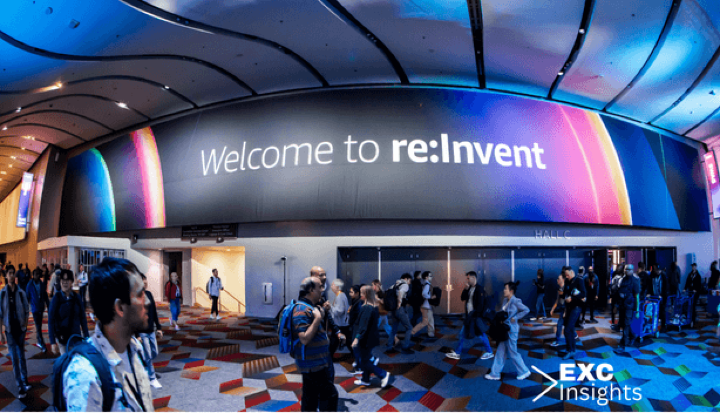
In this report...
- The Dawn of the Agentic Enterprise: An overview of the event's central theme—the shift from experimental AI to autonomous agents that drive business value.
- The Foundation: Reimagined Infrastructure for AI: A breakdown of key announcements in custom silicon, compute instances, and on-premises AI infrastructure.
- The AI Engine: Expanding the Enterprise Toolkit: A summary of new models and services, including major updates to Amazon Bedrock and tools for leveraging proprietary data.
- Putting Agents to Work: From Development to Deployment: An exploration of the new platforms and tools designed to build, manage, and secure AI agents at scale.
- Spotlight on Innovation: Customer and Partner Success Stories: A curated look at how leading companies are achieving transformative results with AWS AI.
- Conclusion and Strategic Takeaways for Leaders: A synthesis of the key messages from re:Invent 2025 and actionable advice for business and technology leaders.
1. The Dawn of the Agentic Enterprise: From Potential to Production
The central theme of AWS re:Invent 2025 marked a definitive industry inflection point: Artificial Intelligence is transitioning from a "technical wonder" into a tangible, measurable driver of business value. The conversation has decisively moved beyond experimental chatbots to focus on the deployment of autonomous AI agents—sophisticated systems capable of reasoning, planning, and executing complex, multi-step tasks on behalf of an organization. AWS executives Matt Garman and Dr. Swami Sivasubramanian articulated a clear vision where AI agents are poised to reinvent every industry. As Garman stated, the future will see "billions of agents inside of every company," fundamentally reshaping workflows and accelerating innovation.
Dr. Sivasubramanian provided a critical and memorable distinction between a simple chatbot and a true agent, framing the difference as "a chatbot tells you what to investigate, whereas an agent investigates, diagnoses, and initiates the solution." Using the example of a sudden drop in website traffic, he explained that a chatbot can only offer helpful advice ("You should check your analytics... look at your server logs"). In contrast, an agent autonomously pulls the analytics data, queries deployment systems for recent code changes, identifies the issue, creates a bug ticket with a proposed fix, and assigns it to the engineering team. This ability to take independent action is what elevates agents from mere assistants to active participants in business operations. This agentic revolution, however, is only possible with a powerful and purpose-built foundation, starting from the silicon up.
2. The Foundation: Reimagined Infrastructure for AI
AWS's core message on infrastructure was unequivocal: achieving optimal AI performance and cost-efficiency requires innovation at every layer of the technology stack, beginning with custom-designed silicon. The announcements at re:Invent 2025 underscored a deep strategic commitment to providing the most powerful and economical foundation for training and running AI models at a global scale. The clear implication is that this custom silicon is the economic engine designed to make the vision of "billions of agents" financially viable at scale, not just a performance upgrade.
Custom Silicon and Compute Enhancements
- Trainium3: Now generally available, Trainium3 UltraServers feature the first three-nanometer AI chip in the AWS Cloud. This new generation delivers a massive performance leap, offering 4.4x more compute performance and an incredible five times more AI tokens per megawatt of power compared to Trainium2. AWS also provided a sneak peek of Trainium4, which is projected to deliver another 6x increase in compute performance.
- Graviton5: AWS introduced the next-generation Graviton5 processor, which integrates 192 cores in one package and provides over five times the L3 cache of its predecessor. This new chip powers the M9g instances, which deliver up to 25% better performance for general-purpose workloads compared to the prior generation.
- New NVIDIA Instances: For customers with the most demanding AI training needs, AWS announced the new P6e-GB300 instances, powered by NVIDIA's latest GB300 NVL72 systems, ensuring continued access to best-in-class third-party hardware.
Bringing AI to the Customer's Data Center
Recognizing that many organizations have stringent data sovereignty and compliance requirements, AWS introduced AWS AI Factories. This new service enables customers to deploy dedicated AI infrastructure from AWS directly within their own data centers. Operating like a private AWS region, AI Factories give customers access to the latest Trainium and NVIDIA hardware, as well as services like Amazon SageMaker and Bedrock, while leveraging their existing data center space and power capacity.
This powerful hardware foundation is intricately linked to the software and managed services that make advanced AI capabilities accessible to developers and businesses worldwide.
3. The AI Engine: Expanding the Enterprise Toolkit
Beyond the hardware, AWS is rapidly expanding its suite of managed services to democratize AI, enabling businesses to build, customize, and deploy sophisticated applications without requiring deep in-house machine learning expertise. This signals a strategic move to provide choice, power, and the tools to unlock the unique value of a company's proprietary data.
Innovations in Amazon Bedrock
Amazon Bedrock, the managed service for accessing and building with foundation models, received significant updates to expand choice and capability:
- Expanded Model Choice: The platform now includes new open-weights models from leading partners, including Mistral AI's Mistral Large & Ministral 3 and Google's Gemma models.
- The Amazon Nova 2 Family: AWS launched a new generation of its own foundation models.
- Nova 2 Lite: A fast and cost-effective model for a broad set of workloads.
- Nova 2 Pro: The most intelligent reasoning model for highly complex tasks, frequently outperforming comparable models in agentic tool use.
- Nova 2 Omni: An industry-first unified model capable of multimodal reasoning across text, image, video, and audio inputs within a single model.
- Reinforcement Fine Tuning (RFT): A major new capability, RFT in Bedrock democratizes one of the most advanced model customization techniques. Bedrock now automates the entire RFT workflow, helping customers improve model accuracy by learning from outcomes, all without needing deep machine learning expertise or large volumes of labeled data.
Unlocking Value with Proprietary Data
AWS stressed that a company's unique data is its primary differentiator in the AI era. To that end, a groundbreaking new service was announced:
- Amazon Nova Forge: This service introduces the concept of "open training models," allowing customers to create their own proprietary frontier models. Customers can blend their private data with Nova training checkpoints at various stages of the training process. This produces custom models, called "Novellas," that possess deep domain-specific knowledge. Unlike traditional fine-tuning, which adds knowledge post-training, Nova Forge integrates proprietary data during the pre-training process, creating models with innate domain understanding rather than a superficial layer of knowledge.
Vector Search and Data Intelligence
Underpinning many AI applications is the ability to perform semantic search across vast datasets. AWS announced key updates in this area:
- S3 Vectors: Now generally available, this service integrates vector storage and search directly into Amazon S3. It is capable of storing trillions of vectors in a single bucket and achieving sub-100 millisecond query times on databases with billions of vectors.
- Nova Multimodal Embeddings: This new model creates a unified vector space, allowing an application to understand the relationships between text, documents, images, video, and audio data simultaneously.
These powerful tools provide the engine for building intelligent models, but AWS also delivered a comprehensive platform for deploying and managing the agents that put them to use.
4. Putting Agents to Work: From Development to Deployment
As AI models grow more capable, the strategic focus shifts to building, managing, and securing the agentic systems that put them into action. Recognizing that agentic autonomy introduces new operational risks, AWS introduced a suite of services designed to provide guardrails for safety, trust, and predictability at scale.
The Agentic Operating System: Amazon Bedrock AgentCore
AWS positioned Amazon Bedrock AgentCore as the industry's most advanced platform—a comprehensive "operating system"—to build, deploy, and operate agents securely at scale. Key new capabilities were announced:
- AgentCore Policy: This provides real-time, deterministic controls for how agents interact with enterprise tools and data. Using natural language or the Cedar policy language, organizations can define strict boundaries on agent actions (e.g., "Block all refunds over $1,000"), ensuring they operate predictably and safely.
- AgentCore Evaluations: This service allows developers to continuously inspect the quality of an agent's behavior against criteria like helpfulness, correctness, and harmfulness. It automates what was previously a complex, manual process, enabling teams to test agents thoroughly before deployment and monitor their performance in production.
- Episodic Memory: This new capability for AgentCore's long-term memory allows agents to remember and learn from past patterns of user behavior, enabling them to proactively offer solutions based on context and similar past situations.
Production-Grade Automation with Amazon Nova Act
To address the need for reliable process automation, AWS announced Amazon Nova Act, a purpose-built service for automating UI workflows with 90% reliability. Trained in "reinforcement learning gyms" on common enterprise workflows, Nova Act agents can navigate browsers and applications just as a human would, reliably completing tasks across diverse interfaces. This represents AWS's solution for production-grade automation that goes far beyond traditional, brittle RPA.
The New Developer Experience
Dr. Werner Vogels introduced the concept of the "Renaissance Developer," a new archetype of builder who is curious, thinks in systems, and communicates with precision. This philosophy is embodied in AWS's agentic development tools.
- Kiro: AWS's agentic development environment is designed to supercharge developer productivity. The keynote announced the launch of the Kiro autonomous agent, a new "frontier agent" that can independently tackle complex tasks from a team's backlog. It can deliver new features, triage bugs, and improve code coverage, acting as a collaborative member of the development team.
- New Frontier Agents: To address the entire software development lifecycle, AWS also launched two other frontier agents designed to work as teammates: the AWS Security Agent, for embedding security reviews and penetration testing from the start, and the AWS DevOps Agent, for proactively investigating and preventing operational incidents.
The Strands Agents SDK is key to building accurate, scalable AI agents with minimal code, eliminating complex orchestration,. This model-driven approach improves agent accuracy and code maintenance. Accelerating time-to-production, the SDK has been downloaded over 5 million times. The AgentCore SDK, providing the foundation for deploying agents securely at scale, has also seen over 2 million downloads.
AWS Transform is an AI service designed to modernize legacy platforms and code, substantially reducing technical debt,. It has analyzed over a billion lines of mainframe code, saving customers over 380 developer years of effort. New features like Transform Custom and Composability accelerate modernization of any code/platform, boosting speed up to 2X,,,.
Amazon Connect is the leading cloud, AI-native contact center solution that transforms customer experiences and operations,. It pioneered AI use for self-service and real-time agent guidance. Connect powers global enterprises, achieved a $1 billion annualized run rate, and offers new conversational AI features for maximum efficiency.
The true test of this technology, however, lies not in its specifications but in the real-world results being achieved by customers and partners.
5. Spotlight on Innovation: Customer and Partner Success Stories
The ultimate measure of any technology platform is its real-world impact. Across keynotes, leaders from every industry demonstrated how they are already leveraging AWS's AI stack to achieve transformative business outcomes, moving well beyond proofs-of-concept into production at scale.
- Sony: Using Nova Forge to fine-tune a model for compliance review, aiming for a 100x increase in efficiency.
- Adobe: Training Adobe Firefly models on P5/P6 instances and using Bedrock to power agentic experiences in products like Adobe Acrobat Studio.
- Toyota: Realized $1 billion in business value and increased customer satisfaction by 15% by building an AI-powered supply chain solution with AWS, McKinsey, and Deloitte.
- Condé Nast: Unified data from 22 publications on AWS and Databricks, shifting revenue to 70% digital and using Bedrock to reduce rights clearance from weeks to minutes.
- Blue Origin: Deployed over 2,700 AI agents on its 'BlueGPT' platform (built on Bedrock), accelerating the product lifecycle by 75% for projects like its T.E.A.R.E.X. lunar battery.
- Writer: Built its Palmyra X5 frontier model on SageMaker HyperPod, reducing training time from six weeks to two, and is now integrating Amazon Bedrock Guardrails into its platform.
These examples represent just a fraction of the innovation underway, signaling a broad and deep adoption of AI-driven strategies across the global enterprise landscape.
6. Conclusion and Strategic Takeaways for Leaders
The overarching message from AWS re:Invent 2025 is clear: the era of speculative AI is over. The focus is now squarely on production-grade, secure, and cost-effective AI that delivers measurable business results. For business and technology leaders, the imperative is to move from experimentation to strategic implementation. The announcements and success stories from the event offer a clear roadmap for this journey.
- Embrace Agentic Transformation: Leaders must look beyond simple AI assistants and proofs-of-concept. The primary strategic opportunity lies in reimagining core business processes—from software development and supply chain management to customer service and compliance—with autonomous agents as integral, value-adding teammates.
- Forge Your Intelligence, Don't Just Fine-Tune It: While general-purpose models provide a powerful baseline, true and sustainable competitive advantage will come from securely infusing proprietary business data and deep domain knowledge into AI systems. Services like Amazon Nova Forge represent a paradigm shift, enabling organizations to build custom frontier models that encapsulate their unique expertise, moving far beyond standard fine-tuning.
- Win the Infrastructure Arbitrage: Performance and cost cannot be afterthoughts in an AI strategy. AWS's deep investments in custom silicon, exemplified by Trainium and Graviton, represent a deliberate strategy to create a cost advantage. This allows enterprises to out-invest competitors on AI model training and inference, making large-scale, enterprise-wide deployment economically viable and sustainable.
- Invest in the Renaissance Developer: The new wave of agentic tools from AWS is not just about productivity; it is designed for a new type of builder—the "Renaissance Developer" who is curious, thinks in systems, and communicates with precision. Leaders must recognize that technological investment must be paired with investment in talent and fostering a culture that empowers these builders to succeed.
- Leverage the Ecosystem: The journey to becoming an AI-driven enterprise should not be undertaken in isolation. The vast AWS Partner Network and the AWS Marketplace provide a critical acceleration layer. Leaders can fast-track their AI initiatives by leveraging pre-built solutions, specialized consulting expertise, and integrated agentic tools from a mature and expanding ecosystem.